
Blogs
Learn expert strategies to run your company more effectively with the articles on this blog.
Guest articles, interviews, and step by step guides are all on there. Search through and enjoy.
Blogs
Learn expert strategies to run your company more effectively with the articles on this blog.
Guest articles, interviews, and step by step guides are all on there. Search through and enjoy.
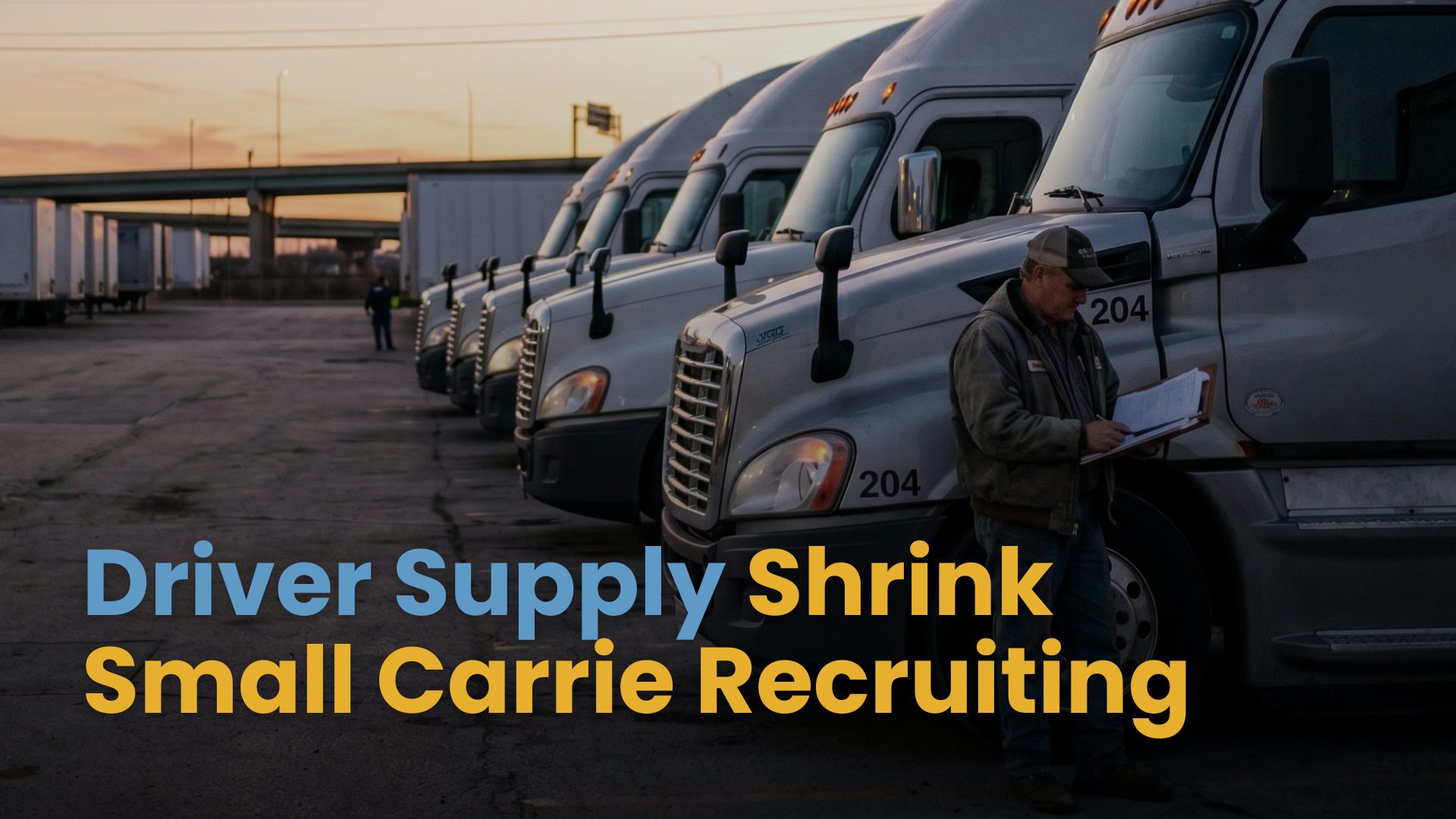
The Triple Squeeze: Why Mid-Sized Fleets are Losing the Battle for Driver Supply
The Driver Supply Is Shrinking From Three Sides.
Small Carriers Feel It First.
In February 2026, the BLS quietly revised its numbers and admitted that 122,000 trucking jobs had vanished from the employment rolls since October 2022. For three years, the industry was planning around a workforce bigger than the one actually out there. The number of for-hire interstate drivers has been below its end-of-2022 level through the first eight months of 2025. The pool isn't growing. It's contracting.
That's the opening problem. The harder one is that the pipeline feeding new drivers in is narrowing at the same time.
The training pipeline just got audited, not stressed
In December 2025, FMCSA pulled roughly 3,000 CDL training providers off the Training Provider Registry for failing federal standards. In January 2026, another 3,800 were removed. Another 4,500 sit on notice. More than 44% of every CDL school in the country is now either gone or under federal scrutiny.
Some of those schools were diploma mills that needed to be shut down. Fair. But the short-term effect is a smaller funnel of newly credentialed drivers. Fewer schools, fewer graduates. Fewer graduates, fewer drivers coming in to replace the ones aging out.
The foreign-born pipeline just got cut too
On March 16, 2026, a federal rule took effect that bars asylum seekers, refugees, DACA recipients, and humanitarian parolees from obtaining or renewing a CDL. Non-domiciled CDLs are now restricted to H-2A, H-2B, and E-2 visa holders. Industry estimates put the active drivers affected at up to 200,000 - roughly 5% of every commercial driver in the country.
Foreign-born drivers currently make up about 18% of the trucking workforce. That share more than doubled between 2000 and 2021, meaning the industry has been quietly leaning on that population for two decades to offset aging out and attrition. That lean just got structurally harder.
Why carriers with 10 to 300 trucks take the hit first
Three forces squeezing supply at once is a problem for every carrier. It's an existential problem for fleets in the 10 to 300 truck range.
Mega-carriers can out-pay, out-bonus, and out-market in ways a mid-size fleet can't. They have national brand recognition, dedicated recruiting teams, and the budget to blanket every channel at once. When the pool shrinks, they scoop first. Everyone else takes what's left.
Small carriers also don't have the financial runway to absorb long vacancies. An empty driver seat costs a carrier $5,000 to $20,000 per month in lost revenue, overtime, and subcontracted loads. A 40-truck fleet with five open seats is bleeding $25,000 to $100,000 every month they can't fill them. A 300-truck fleet with 30 open seats is in real trouble.
And most small carriers are still recruiting the way they were recruiting five years ago. Indeed. Job boards. Word of mouth. That's the part that has to change.
The math shifts against job-board recruiting first
There's a concept worth knowing here called the Satisfaction Spectrum. Every driver falls somewhere between "actively seeking a new job" on one end and "fully satisfied, hasn't applied anywhere in years" on the other. The drivers you most want to hire - stable, long-tenured, reliable - sit on the satisfied end. They haven't crossed into "apply mode."
Job boards can only reach drivers who've already decided to apply. That's the activated end of the spectrum, and it's the part of the pool that contracts fastest. When total supply gets tighter, the actively-applying subset shrinks at an even faster rate, because fewer drivers are in motion at all.
So carriers running Indeed-only recruiting are fishing in the slice of the pool that's disappearing. The drivers they actually need - stable, not looking, satisfied where they are - aren't there. They're on Facebook, scrolling at a truck stop between loads. They're not going to type "trucking jobs near me" into a job board. They might respond to the right ad with the right message while they're already on their phone.
The playbook has to change
The carriers that adapt over the next twelve months will be the ones that stop competing for the loudest 10% of the pool and start reaching the quiet 90%. That means targeted social advertising instead of passive postings. It means benchmarking your offer against what competitors are actively advertising in your market, so you don't bleed conversions on something you didn't know was uncompetitive. It means a recruiting process tight enough to close quality drivers when they do show interest - not one that loses them to a five-day callback delay.
This is the problem M3Traffic was built to solve. If your trucks are sitting empty while the supply keeps tightening, we should talk.

Download Our Rocket Recruiting Template
Easy 4 Step Roadmap To
Double Your Fleet in 2024
The Triple Squeeze: Why Mid-Sized Fleets are Losing the Battle for Driver Supply
The Driver Supply Is Shrinking From Three Sides.
Small Carriers Feel It First.
In February 2026, the BLS quietly revised its numbers and admitted that 122,000 trucking jobs had vanished from the employment rolls since October 2022. For three years, the industry was planning around a workforce bigger than the one actually out there. The number of for-hire interstate drivers has been below its end-of-2022 level through the first eight months of 2025. The pool isn't growing. It's contracting.
That's the opening problem. The harder one is that the pipeline feeding new drivers in is narrowing at the same time.
The training pipeline just got audited, not stressed
In December 2025, FMCSA pulled roughly 3,000 CDL training providers off the Training Provider Registry for failing federal standards. In January 2026, another 3,800 were removed. Another 4,500 sit on notice. More than 44% of every CDL school in the country is now either gone or under federal scrutiny.
Some of those schools were diploma mills that needed to be shut down. Fair. But the short-term effect is a smaller funnel of newly credentialed drivers. Fewer schools, fewer graduates. Fewer graduates, fewer drivers coming in to replace the ones aging out.
The foreign-born pipeline just got cut too
On March 16, 2026, a federal rule took effect that bars asylum seekers, refugees, DACA recipients, and humanitarian parolees from obtaining or renewing a CDL. Non-domiciled CDLs are now restricted to H-2A, H-2B, and E-2 visa holders. Industry estimates put the active drivers affected at up to 200,000 - roughly 5% of every commercial driver in the country.
Foreign-born drivers currently make up about 18% of the trucking workforce. That share more than doubled between 2000 and 2021, meaning the industry has been quietly leaning on that population for two decades to offset aging out and attrition. That lean just got structurally harder.
Why carriers with 10 to 300 trucks take the hit first
Three forces squeezing supply at once is a problem for every carrier. It's an existential problem for fleets in the 10 to 300 truck range.
Mega-carriers can out-pay, out-bonus, and out-market in ways a mid-size fleet can't. They have national brand recognition, dedicated recruiting teams, and the budget to blanket every channel at once. When the pool shrinks, they scoop first. Everyone else takes what's left.
Small carriers also don't have the financial runway to absorb long vacancies. An empty driver seat costs a carrier $5,000 to $20,000 per month in lost revenue, overtime, and subcontracted loads. A 40-truck fleet with five open seats is bleeding $25,000 to $100,000 every month they can't fill them. A 300-truck fleet with 30 open seats is in real trouble.
And most small carriers are still recruiting the way they were recruiting five years ago. Indeed. Job boards. Word of mouth. That's the part that has to change.
The math shifts against job-board recruiting first
There's a concept worth knowing here called the Satisfaction Spectrum. Every driver falls somewhere between "actively seeking a new job" on one end and "fully satisfied, hasn't applied anywhere in years" on the other. The drivers you most want to hire - stable, long-tenured, reliable - sit on the satisfied end. They haven't crossed into "apply mode."
Job boards can only reach drivers who've already decided to apply. That's the activated end of the spectrum, and it's the part of the pool that contracts fastest. When total supply gets tighter, the actively-applying subset shrinks at an even faster rate, because fewer drivers are in motion at all.
So carriers running Indeed-only recruiting are fishing in the slice of the pool that's disappearing. The drivers they actually need - stable, not looking, satisfied where they are - aren't there. They're on Facebook, scrolling at a truck stop between loads. They're not going to type "trucking jobs near me" into a job board. They might respond to the right ad with the right message while they're already on their phone.
The playbook has to change
The carriers that adapt over the next twelve months will be the ones that stop competing for the loudest 10% of the pool and start reaching the quiet 90%. That means targeted social advertising instead of passive postings. It means benchmarking your offer against what competitors are actively advertising in your market, so you don't bleed conversions on something you didn't know was uncompetitive. It means a recruiting process tight enough to close quality drivers when they do show interest - not one that loses them to a five-day callback delay.
This is the problem M3Traffic was built to solve. If your trucks are sitting empty while the supply keeps tightening, we should talk.
Download Our Rocket Recruiting Template
Easy 4 Step Roadmap To Double Your Fleet in 2026