
Blogs
Learn expert strategies to run your company more effectively with the articles on this blog.
Guest articles, interviews, and step by step guides are all on there. Search through and enjoy.
Blogs
Learn expert strategies to run your company more effectively with the articles on this blog.
Guest articles, interviews, and step by step guides are all on there. Search through and enjoy.
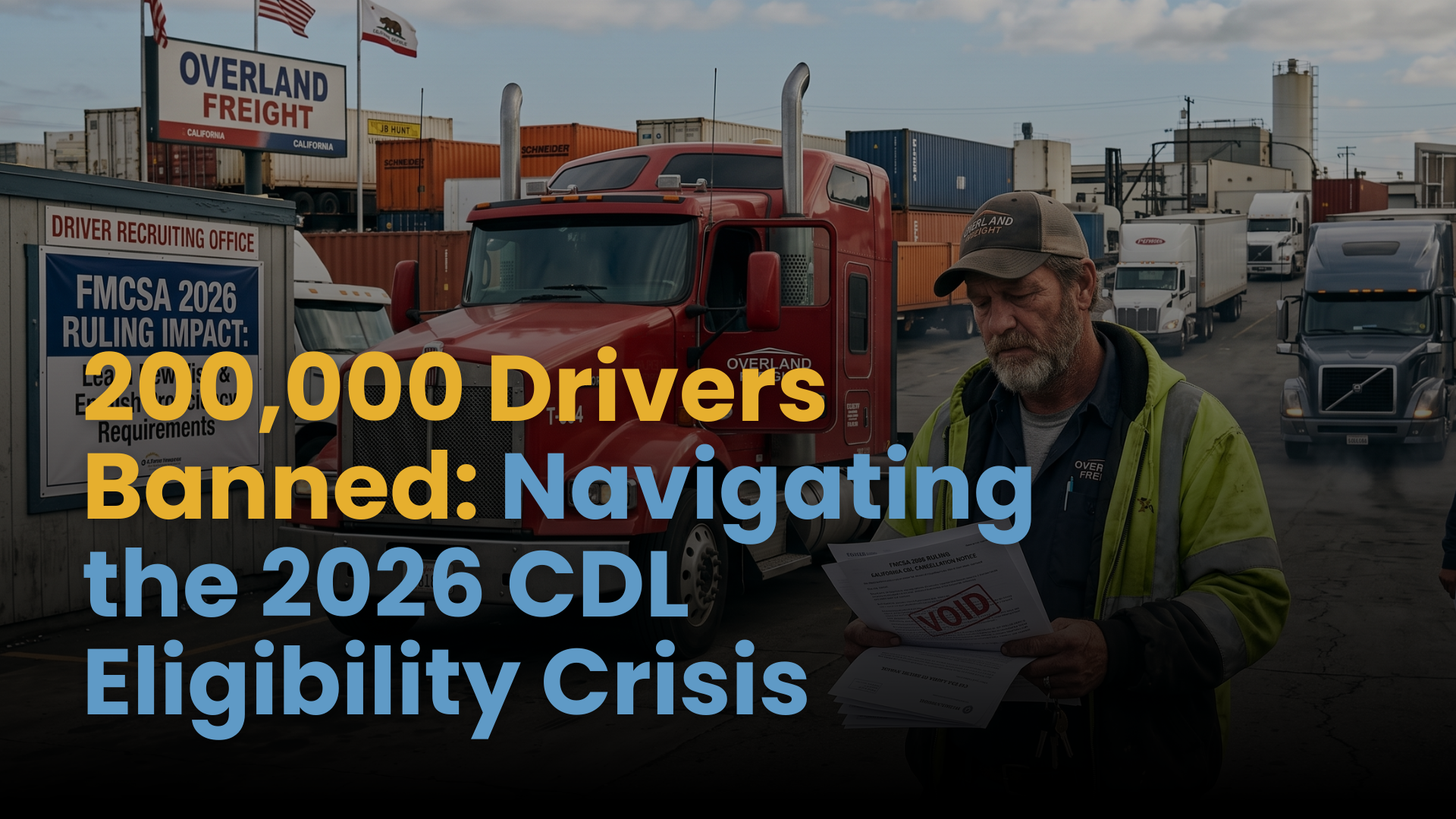
200,000 Drivers Banned: Navigating the 2026 CDL Eligibility Crisis
The Driver Pool Just Shrank by 200,000.
What That Means for Your Recruiting.
On March 6, 2026, the California DMV canceled 13,000 commercial driver's licenses in a single day. Not suspended. Canceled. Drivers who had been hauling freight safely for years - some for more than a decade - showed up to work and found out their CDLs were gone.
That was the first visible wave of a much bigger policy change. And if you're a carrier trying to fill driver seats right now, you need to understand what happened - because it's going to affect every hiring conversation you have for the next five years.
What Changed
In February 2026, FMCSA finalized a new rule that stripped CDL eligibility from the vast majority of non-citizen, non-domiciled drivers. DACA recipients, asylum seekers, refugees, TPS holders - if your work authorization came through an Employment Authorization Document rather than an H-2A, H-2B, or E-2 visa, you no longer qualify for renewal. FMCSA's own estimate: 194,000 of the approximately 200,000 affected drivers won't make it through the new requirements.
That's 5% of the total CDL workforce. Gone. Not all at once - licenses don't expire simultaneously - but steadily, as renewals come due over the next five years.
Then there's the English proficiency piece. A requirement that's been on the books since 1937, but wasn't enforced after 2016, is back. As of last June, a driver who can't demonstrate basic English proficiency at a roadside inspection gets placed out of service on the spot. More than 3,000 commercial drivers have already been sidelined this way. Analysts estimate 40,000 to 60,000 more are at risk.
The Numbers Behind the Problem
Foreign-born drivers make up 18% of the U.S. truck driver workforce - over 720,000 people. California alone could lose 61,000 immigrant truck drivers in the coming months. The American Trucking Associations had already pegged the national driver shortage at 60,000 to 82,000 before any of this started.
Add 200,000 potential losses to a deficit that was already at 80,000. That's not a math problem. That's a hiring environment that's going to get measurably harder for every carrier running ads on Indeed and hoping volume carries them through.
And the fear factor is real. Even drivers who technically still qualify are leaving. Companies in California are reporting drivers quitting routes to states where they feel targeted. Entire communities - Sikh truckers were cited specifically in industry reporting - are walking away from the profession because of the harassment they're encountering at roadside stops. Legal eligibility and practical availability aren't the same thing right now.
Where You Fish Matters More When the Pond Is Smaller
Here's the thing most carriers haven't connected yet: when the supply side of the driver market contracts, the channel you use to recruit matters more, not less.
Think about how drivers actually exist in the market. On one end, you have drivers who are fully employed, not looking, comfortable where they are. On the other end, you've got drivers who've already crossed into active job-hunt mode - on job boards, submitting applications, open to anything reasonable.
Job boards can only reach drivers who've already made that move. By definition, a driver has to be actively looking to show up on Indeed. That pool of actively-looking drivers just got smaller. And the drivers who tend to be in that pool - the ones browsing job boards, submitting applications everywhere - aren't usually the ones you most want to hire.
The quality drivers - four years with one company, clean record, not bouncing - they're not on Indeed. They haven't been for years. They'd consider a move if the right thing showed up in front of them, but they're not out there hunting.
The carriers who are filling seats in this environment aren't posting more listings. They're reaching drivers who aren't actively looking yet - through targeted social media advertising that finds drivers based on where they live, not based on whether they've filed an application somewhere. That's the pool your competitors haven't touched.
Your Offer Competitiveness Matters More Right Now
Supply drops. Demand stays roughly the same. That means every eligible driver in your market has more options than they did six months ago. A driver who was mildly interested in your ad last year is getting five more ads in his feed today.
If your compensation package isn't competitive, you're not losing to the void. You're losing to the carrier down the road who ran the numbers and adjusted their offer before launching a campaign.
Before a single ad runs, you need to know where your offer stands. Not in your gut - in the data. What are comparable carriers in your area actually advertising? Where are you strong, and where are you giving ground you don't have to give? Paying a few cents per mile below the regional average while competitors offer a sign-on bonus you're skipping is a fixable problem - but only if you know it exists.
In a tighter driver market, offer competitiveness isn't a nice-to-have. It's the difference between your ads converting and your ads burning budget.
What This Means for You
The trucking industry was already short drivers. 2026 made it shorter. The carriers who adapt their approach - reaching drivers who aren't job hunting, benchmarking their offer against what's actually in the market, and building a real funnel instead of hoping volume carries them through - are going to hire the best available drivers. The rest are going to compete for a shrinking pool with the same tools they've always used.
This is exactly the problem M3Traffic was built for. If your trucks are sitting empty while your ads run, we'd love to talk.

Download Our Rocket Recruiting Template
Easy 4 Step Roadmap To
Double Your Fleet in 2024
200,000 Drivers Banned: Navigating the 2026 CDL Eligibility Crisis
The Driver Pool Just Shrank by 200,000.
What That Means for Your Recruiting.
On March 6, 2026, the California DMV canceled 13,000 commercial driver's licenses in a single day. Not suspended. Canceled. Drivers who had been hauling freight safely for years - some for more than a decade - showed up to work and found out their CDLs were gone.
That was the first visible wave of a much bigger policy change. And if you're a carrier trying to fill driver seats right now, you need to understand what happened - because it's going to affect every hiring conversation you have for the next five years.
What Changed
In February 2026, FMCSA finalized a new rule that stripped CDL eligibility from the vast majority of non-citizen, non-domiciled drivers. DACA recipients, asylum seekers, refugees, TPS holders - if your work authorization came through an Employment Authorization Document rather than an H-2A, H-2B, or E-2 visa, you no longer qualify for renewal. FMCSA's own estimate: 194,000 of the approximately 200,000 affected drivers won't make it through the new requirements.
That's 5% of the total CDL workforce. Gone. Not all at once - licenses don't expire simultaneously - but steadily, as renewals come due over the next five years.
Then there's the English proficiency piece. A requirement that's been on the books since 1937, but wasn't enforced after 2016, is back. As of last June, a driver who can't demonstrate basic English proficiency at a roadside inspection gets placed out of service on the spot. More than 3,000 commercial drivers have already been sidelined this way. Analysts estimate 40,000 to 60,000 more are at risk.
The Numbers Behind the Problem
Foreign-born drivers make up 18% of the U.S. truck driver workforce - over 720,000 people. California alone could lose 61,000 immigrant truck drivers in the coming months. The American Trucking Associations had already pegged the national driver shortage at 60,000 to 82,000 before any of this started.
Add 200,000 potential losses to a deficit that was already at 80,000. That's not a math problem. That's a hiring environment that's going to get measurably harder for every carrier running ads on Indeed and hoping volume carries them through.
And the fear factor is real. Even drivers who technically still qualify are leaving. Companies in California are reporting drivers quitting routes to states where they feel targeted. Entire communities - Sikh truckers were cited specifically in industry reporting - are walking away from the profession because of the harassment they're encountering at roadside stops. Legal eligibility and practical availability aren't the same thing right now.
Where You Fish Matters More When the Pond Is Smaller
Here's the thing most carriers haven't connected yet: when the supply side of the driver market contracts, the channel you use to recruit matters more, not less.
Think about how drivers actually exist in the market. On one end, you have drivers who are fully employed, not looking, comfortable where they are. On the other end, you've got drivers who've already crossed into active job-hunt mode - on job boards, submitting applications, open to anything reasonable.
Job boards can only reach drivers who've already made that move. By definition, a driver has to be actively looking to show up on Indeed. That pool of actively-looking drivers just got smaller. And the drivers who tend to be in that pool - the ones browsing job boards, submitting applications everywhere - aren't usually the ones you most want to hire.
The quality drivers - four years with one company, clean record, not bouncing - they're not on Indeed. They haven't been for years. They'd consider a move if the right thing showed up in front of them, but they're not out there hunting.
The carriers who are filling seats in this environment aren't posting more listings. They're reaching drivers who aren't actively looking yet - through targeted social media advertising that finds drivers based on where they live, not based on whether they've filed an application somewhere. That's the pool your competitors haven't touched.
Your Offer Competitiveness Matters More Right Now
Supply drops. Demand stays roughly the same. That means every eligible driver in your market has more options than they did six months ago. A driver who was mildly interested in your ad last year is getting five more ads in his feed today.
If your compensation package isn't competitive, you're not losing to the void. You're losing to the carrier down the road who ran the numbers and adjusted their offer before launching a campaign.
Before a single ad runs, you need to know where your offer stands. Not in your gut - in the data. What are comparable carriers in your area actually advertising? Where are you strong, and where are you giving ground you don't have to give? Paying a few cents per mile below the regional average while competitors offer a sign-on bonus you're skipping is a fixable problem - but only if you know it exists.
In a tighter driver market, offer competitiveness isn't a nice-to-have. It's the difference between your ads converting and your ads burning budget.
What This Means for You
The trucking industry was already short drivers. 2026 made it shorter. The carriers who adapt their approach - reaching drivers who aren't job hunting, benchmarking their offer against what's actually in the market, and building a real funnel instead of hoping volume carries them through - are going to hire the best available drivers. The rest are going to compete for a shrinking pool with the same tools they've always used.
This is exactly the problem M3Traffic was built for. If your trucks are sitting empty while your ads run, we'd love to talk.
Download Our Rocket Recruiting Template
Easy 4 Step Roadmap To Double Your Fleet in 2026